
The journal
What is the best coffee scale to use for espresso? A measurement-first guide
Practical guide to coffee scale accuracy espresso, testing, and choosing scales that perform for home and professional espresso.
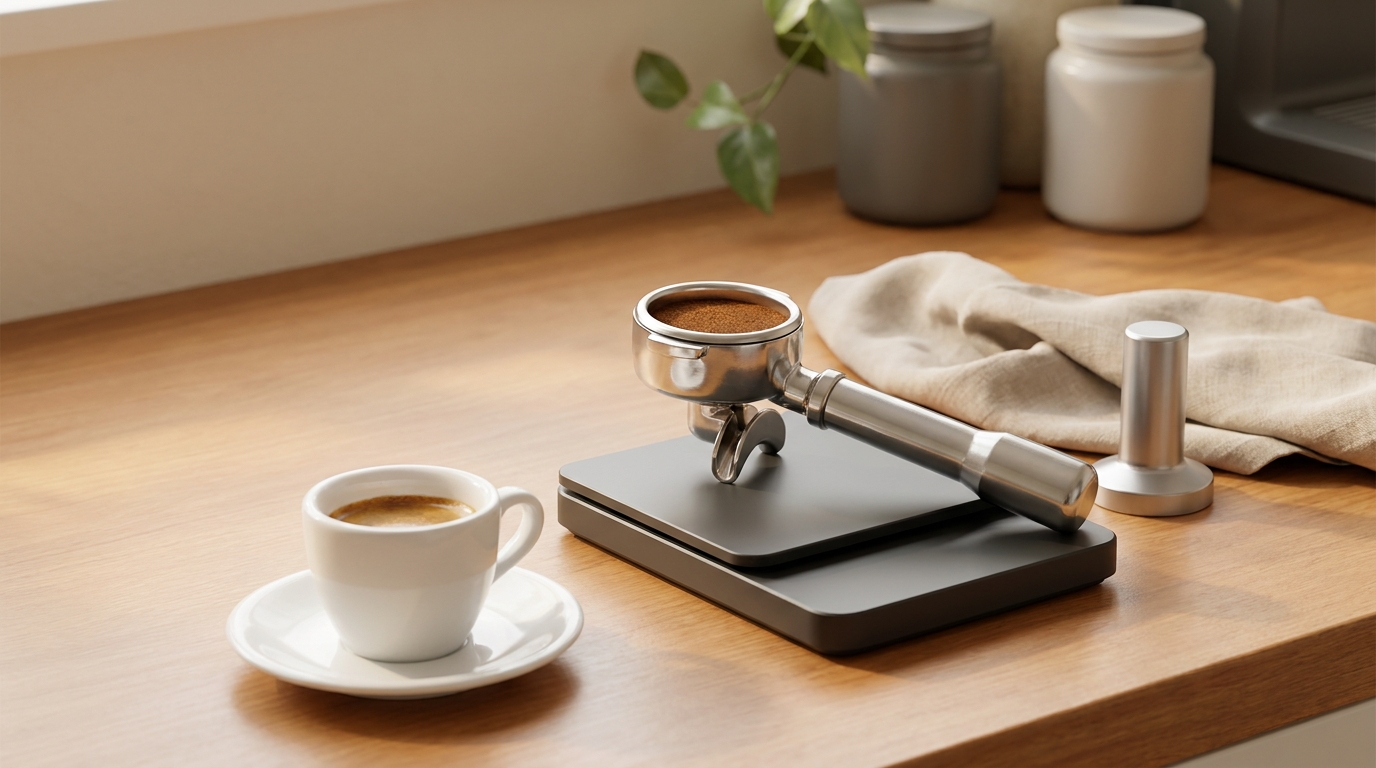
Why accuracy and response matter for espresso
Espresso is a precision beverage: small differences in dose and yield change extraction and taste. Understanding coffee scale accuracy espresso at the bench means separating three related concepts that are often conflated: accuracy, which describes how close a scale's reading is to the true mass; precision or repeatability, which describes how consistently the scale returns the same reading under identical conditions; and resolution, the smallest increment the display shows. For formal assessment of accuracy and tolerances on non-automatic weighing instruments, NIST Handbook 44 remains the practical reference for technical definitions and test procedures for weighing devices.
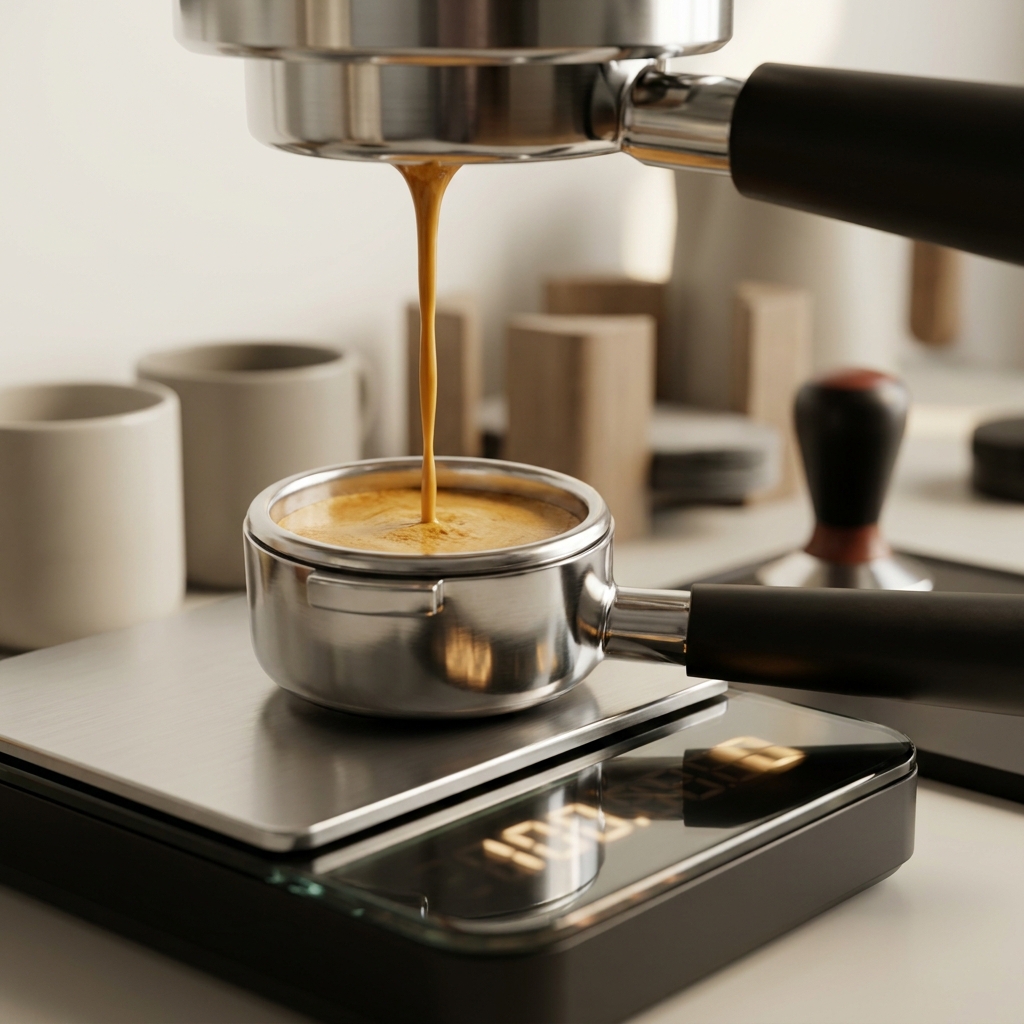
Resolution alone, such as a 0.1 g display increment, is not a guarantee that the device reports true mass to that level across its usable range. A scale can show 0.1 g increments but have bias, poor linearity, or slow stabilization that makes following an espresso pull or flow-tracking workflow unreliable. In editorial lab testing, reviewers have repeatedly found differences in stabilization behavior and usability that matter more than raw resolution when tracking pours Wirecutter.
What counts in practice is a blend of accuracy and response. A fast, stable reading lets you track dose and yield during a pour, measure beverage weight at the cup, and compare extractions consistently. Competition rules add operational pressure: the World Barista Championship sets beverage weight requirements that make rapid, repeatable scale readings operationally important in professional service World Barista Championship Rules.
Failing to account for stabilization time or poor repeatability creates errors that affect dose control more than a single-digit resolution spec. For example, a slow-reading scale can lag behind a changing mass during flow tracking, causing the barista to misjudge yield or make compensating adjustments that produce inconsistent results.
What is the best coffee scale to use for espresso?
The best scale balances proven accuracy and repeatability with fast stabilization and usable ergonomics for your workflow; verify with repeatability and response tests before buying.
That practical problem is why many serious operators and trainers test scales not by the number on the spec sheet but by timed trials and repeatability checks that mirror real pours.
What accuracy, precision and resolution mean in practice
Accuracy is about truth to mass: if you place a certified 100 g check weight on a scale, the reported number should fall within the instrument tolerance for that mass. Precision or repeatability is about scatter: if you place the same weight multiple times under the same conditions, the variance in readings should be small. Resolution is what the display shows, and it helps read small changes, but a visible 0.1 g digit is only useful if the scale is accurate and repeatable at that level.
How small weight differences change espresso yield and taste (coffee scale accuracy espresso)
Because espresso doses and yields are relatively small compared with other brewed methods, a few grams of difference in dose or yield can shift strength and extraction. That makes both low absolute error and tight repeatability critical: a biased scale that adds or subtracts a gram systematically will shift your brew ratios, while a scale with variable readings will increase scatter across shots even if its average is accurate.
Regulatory and competition context
Buyers should understand that metrology and competition frameworks influence the expectations for performance. NIST Handbook 44 provides formal definitions and test procedures that laboratories and regulators use to evaluate weighing instruments, which is a useful baseline when translating manufacturer specs into what you can realistically expect in the cup.
At the same time, competition rules such as those used by the World Barista Championship create real-world needs for fast stabilization and consistent repeatability during service, which is why many judges and trainers expect scales to behave predictably under timed conditions World Barista Championship Rules.
How scales are tested for espresso use: the core metrics
When testing or selecting a scale for espresso, focus on a short list of measurable metrics you can reproduce: accuracy across representative masses, repeatability under repeated trials, response and stabilization time while tracking a pour, tare latency, usable capacity and linearity across the working range, and ergonomics such as display readability and water resistance. These metrics map closely to both metrology standards and editorial test programs that evaluate real-world behavior OIML R 76-1.
Accuracy and repeatability testing methods
Repeatability is a formal concept in OIML R 76-1 and is evaluated by repeated indications under identical conditions, which mirrors how baristas need consistent readings shot to shot; this standard provides a structured way to measure scatter and report repeatability in a way technicians and lab testers can compare OIML R 76-1.
For a simple home protocol, that means using a known mass or a set of common weights and recording multiple placements and removals to compute the spread of readings. Editorial labs typically use this same approach with calibrated weights to report standard deviation or maximum deviation across trials.
Response, stabilization and tare latency
Stabilization time is the interval between placing a changing load or starting a pour and the scale delivering a stable reading you can use to act. For espresso, short stabilization time and low tare latency matter because you often tare mid-routine and watch a fast-changing mass as liquid leaves a basket or cup. Editorial testing has shown that models with similar resolution can behave very differently in stabilization and tare responsiveness, affecting workflow more than resolution numbers alone Serious Eats.
To test this at home, time how long the display takes to settle during a controlled pour and check that tare clears quickly and predictably when you press it. If a scale shows wild fluctuations or takes long to stabilize, it will frustrate flow tracking and dose adjustments.
Capacity, linearity and ergonomics
Capacity is a practical limit: espresso workflows often need a scale that handles portafilter plus coffee, so platform size and capacity matter. Linearity means that the scale's error does not change unpredictably across its range; testing at low, mid and high points within the usable range is more informative than a single-point spec.
Ergonomics is not optional: a readable display under steam and low light, physical buttons that work with wet hands, a platform that fits your portafilter, and an auto-off delay or disable option all influence whether a technically accurate scale is usable in practice. Independent editorial tests repeatedly highlight usability as a differentiator across models with similar spec sheets Wirecutter.
How to choose the right coffee scale for espresso: decision criteria
Choosing a scale is about matching objective performance to your workflow. Prioritize tested accuracy and repeatability first, then response and stabilization time, then usable capacity and platform size. If you train for competitions or run a busy cafe, give more weight to fast stabilization, robust construction, and water resistance. For home users a balance of readability, reliable accuracy at the dose range you use, and a stable timer may be the best choice.
Certification and regional rules matter for buyers in regulated markets. In the EU, the NAWI Directive 2014/31/EU sets essential requirements and conformity assessment pathways for non-automatic weighing instruments, which affects how some devices are marketed and certified for trade use in Europe NAWI Directive 2014/31/EU.
Editorial tests provide practical insights beyond manufacturer claims: reviewers have found meaningful differences in accuracy and stabilization among consumer scales, so pay attention to lab-tested behavior for features like tare latency and display stability rather than relying on resolution alone Wirecutter. Also see our editorial tests for practical examples.

Below is a short checklist of prioritized criteria to use when shortlisting models: look for documented repeatability or independent test data, a stabilization time suitable for flow tracking, capacity and platform dimensions that fit your portafilter or cup, a built-in timer or easy integration with a phone, and water-resistant controls or a sealed platform for cleaning. Match these features to your primary use case before choosing a model.
Matching scale specs to your workflow
For a daily home user who single-doses, a scale that is accurate and repeatable in the 10 g to 1000 g window, with a platform that fits a portafilter and a readable display, is ideal. For cafe operators, prioritize capacity and fast stabilization, and consider a model with a larger platform and a water-resistant surface. Competition trainers should prioritize fastest possible stabilization and tested repeatability to meet judged beverage weight expectations World Barista Championship Rules.
Certification, region rules and what they mean
If you sell by weight in Europe, NAWI conformity matters for legal trade use, but for most cafe or home espresso buyers conformity markings are less relevant than measured performance in the dose and yield range you use. If a vendor claims trade certification, verify the claim against the product documentation and, where available, independent test reports NAWI Directive 2014/31/EU.
Usability features that matter in daily use
Prefer models with clearly legible displays in low light, physical buttons that work with wet or flour-covered hands, an adjustable auto-off or disable option, and a platform large enough for your workflow. Editorial reviews often highlight these real-world ergonomics as the deciding factor between two otherwise similar scales Serious Eats.
Common mistakes and pitfalls when picking an espresso scale
One frequent mistake is buying for resolution alone. A 0.1 g display does not ensure true accuracy, and buyers who prioritize the smallest visible increment may discover slow response or poor repeatability in practice. Independent tests have demonstrated meaningful differences among models that share similar resolution claims Wirecutter.
Another pitfall is ignoring response time and ergonomics. A compact, highly sensitive scale with a tiny platform may show precise numbers but be impractical with a portafilter or during timed service. Look for a balance between sensitivity and usable platform size.
Assuming lab results always match real-world use is also dangerous. Editorial labs try to replicate practical workflows, but your setup, humidity, and how you tare mid-pull can expose different weaknesses. Use lab results as a guide and test a shortlisted scale in your environment when possible Serious Eats.
Practical examples and recommended workflows by use case
Home espresso workflow: single-dosing, dose on the scale, tamp off the scale if preferred, and use the scale timer to track extraction. For a home user the priority is a stable, readable display and consistent repeatability in the dose range you use. Test a candidate by measuring a typical dose several times and performing a short pour to watch stabilization.
Cafe workflow: prioritize capacity and fast stabilization so the scale handles a portafilter or grouphead tray and recovers quickly between shots. Water resistance and a platform that is easy to wipe are practical must-haves in a busy environment. Editorial testing suggests ergonomics and response often drive selection for operators even when multiple models share similar specs Wirecutter.
Competition and training: professionals need the most repeatable readings and the fastest stabilization practically available to meet beverage weight requirements under time pressure. Training to the rules means verifying that your chosen scale reliably reports consistent mass during timed pours and that your workflow allows repeatable taring and yield measurement World Barista Championship Rules.
Practical testing tips for any scenario: measure a typical dose with a set of repeated trials to confirm repeatability, time a controlled pour to estimate stabilization time, and test tare latency during a mock extraction. If possible, test the scale with a portafilter or cup you use so platform fit and readability are confirmed.
How to verify and calibrate a scale at home and next steps
Start with repeatability checks that follow the spirit of metrology test methods: use a known mass or household equivalents, place the load, record the reading, remove and repeat at least five to ten times to estimate spread. OIML describes repeatability testing using repeated indications under identical conditions as a formal method to quantify scatter, and you can apply that principle to your home checks to decide if a scale meets your needs OIML R 76-1.
Next, measure stabilization time by performing a controlled pour or adding small incremental masses and timing how long until the reading settles. Also measure tare latency by pressing tare during simulated workflow events and noting any delay or unusual behavior.
A simple verification checklist to test accuracy and repeatability at home
Interpreting results: small, consistent variance across repeated placements suggests good repeatability; a consistent offset from known weights indicates bias that calibration can correct. If your scale shows large scatter or inconsistent linearity across the range you use, consider professional calibration or a replacement model that demonstrates better measured performance.
When to seek professional calibration or replacement: if a calibrated test weight shows bias beyond the tolerance you need for consistent espresso results, or if repeatability falls short of your operational requirements, professional calibration is the next step for instruments designed to be serviceable. For most consumer and prosumer scales, replacement with a model that has better independent test data is often more cost-effective than formal calibration.
Simple verification tests to check accuracy and repeatability
Use a certified weight if available, or common household standards like a sealed 1 kg food package, a 500 g packet, and a set of coins to test at multiple points. Place each mass onto the scale, record the reading, lift and repeat at least five times to estimate variance. If you observe systematic offsets or wide scatter, the scale may not be suitable for precise espresso work.
Measuring stabilization time and tare latency
To measure stabilization, start a controlled pour or add a small incremental mass and use a stopwatch to time until the displayed value ceases to fluctuate. For tare latency, press tare during a simulated workflow and record the delay until the display updates. Document these times across runs to build a practical sense of how the device behaves under load.
When to seek professional calibration or replacement
Formal calibration pathways are described by national metrology and conformity frameworks, and NIST guidance and OIML standards describe how tolerance and test procedures are defined for weighing instruments; consult these sources when a formal calibration certificate is required for trade or official uses.
Frequently asked questions
How accurate does a scale need to be for espresso?
A scale should be accurate enough to give small, consistent errors within the dose range you use; prioritize repeatability and stable readings over resolution alone.
Can I test my scale at home without certified weights?
Yes, use sealed food packets and coins at multiple masses, perform repeated placements, and time stabilization to estimate bias and repeatability.
Is a 0.1 g resolution always necessary for espresso?
Not always; resolution helps, but accuracy, repeatability and fast stabilization are more important for consistent espresso results.
Choosing the right scale for espresso comes down to measurable performance in your workflow, not the smallest number on a spec sheet. Use the checklists and tests in this guide to verify repeatability and stabilization before you commit, and prioritize ergonomics that keep your workflow fast and reliable. If your tests show consistent bias or wide scatter, consider professional calibration only for instruments intended for trade or look for a replacement model with better independent test data.
References
- https://worldcoffeeevents.org/rules/
- https://www.oiml.org/en/files/pdf_r/r076-1-e06.pdf
- https://www.seriouseats.com/best-kitchen-scales-5092613
- https://eur-lex.europa.eu/legal-content/EN/TXT/?uri=CELEX:32014L0031
- https://www.nist.gov/pml/owm/faqs/weighing-and-scales-faqs
- https://www.nist.gov/news-events/news/2024/06/considerations-class-ii-scale-applications
- https://www.seriouseats.com/best-coffee-scales-6361787
- https://groundandgauge.com/guides/espresso/
- https://groundandgauge.com/journal/espresso-ratios/
- https://groundandgauge.com/how-we-choose/
Product options for this topic
As an Amazon Associate I earn from qualifying purchases. These are researched options, not hands-on test results. Check the exact size or model, current price and availability on Amazon.
| Product option | Fit and limits to check | Retailer |
|---|---|---|
| Timemore Black Mirror Basic 2.0 scale | A scale-and-timer option for repeatable brewing. Check that its platform fits your espresso machine drip tray or brewing vessel. | View on Amazon |