
The journal
Why are burr coffee grinders better? A clear, evidence-based guide
coffee grinder burr vs blade explained, with evidence-based reasons why burr grinders give more consistent extraction and better cup clarity.
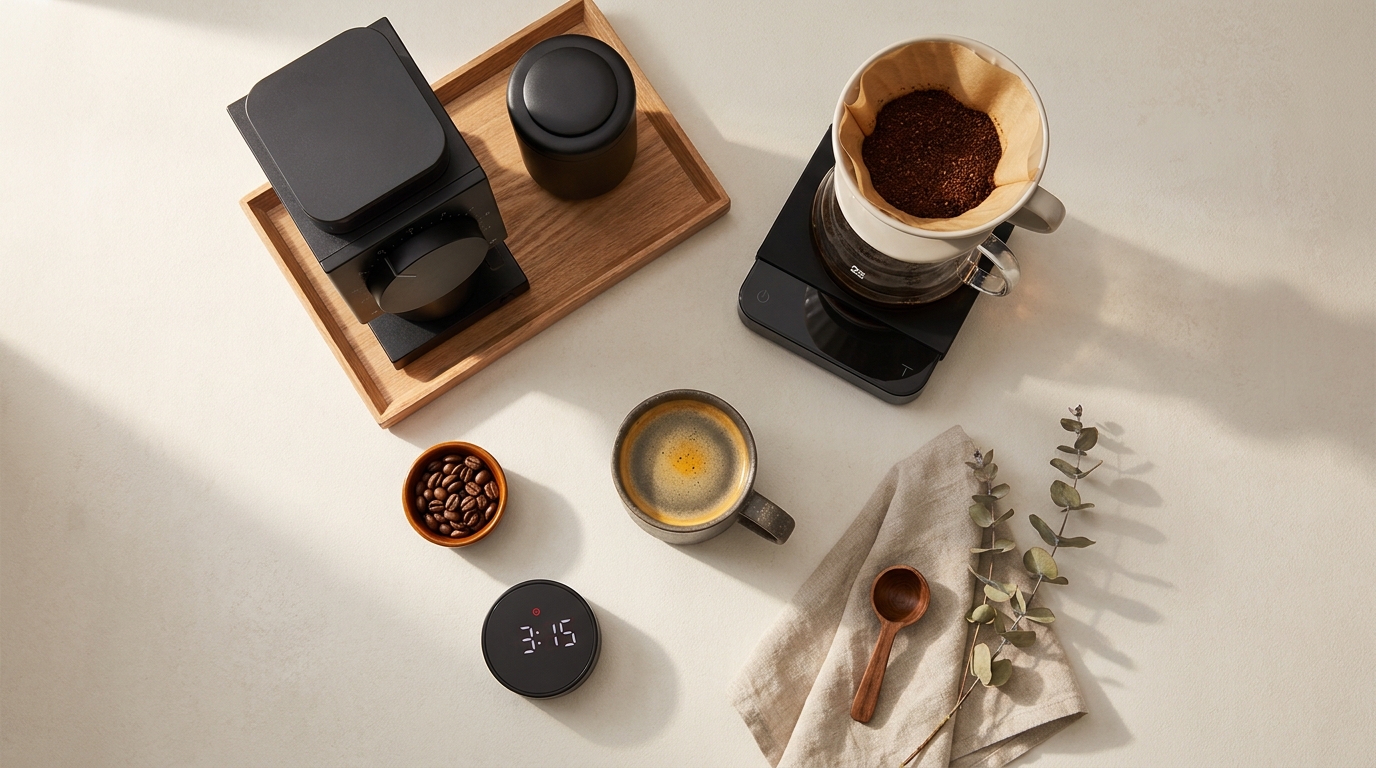
What a burr grinder is and why particle size matters
A burr grinder crushes coffee beans between two abrasive surfaces called burrs, producing fragments whose sizes are set largely by the burr spacing and geometry. This crush-based action yields a controlled range of particle sizes rather than the random chopping produced by a spinning blade; for a clear explanation of how mechanics shape particle outcomes, see Barista Hustle.
Why are burr grinders generally preferred over blade grinders?
Burr grinders produce a narrower, more controllable particle-size distribution that makes extraction more even and predictable, which helps home brewers hit brewing targets and get more consistent cup quality.
That difference in how particles are formed matters because extraction depends on how water flows around and through the bed of ground coffee. A narrower particle-size distribution and fewer fines give more predictable flow and therefore more consistent extraction when you follow a recipe or the SCA Golden Cup targets for brewed coffee, which are widely used as a practical benchmark for repeatable results.
When beans are chopped by a blade, the result is a broad mix of fines and large pieces that extract at different rates. That mix makes it harder to dial in recipes and leads to cups that can shift between underextraction and overextraction as dose or grind setting varies; Consumer Reports testing and expert writeups note this variability in their comparisons.
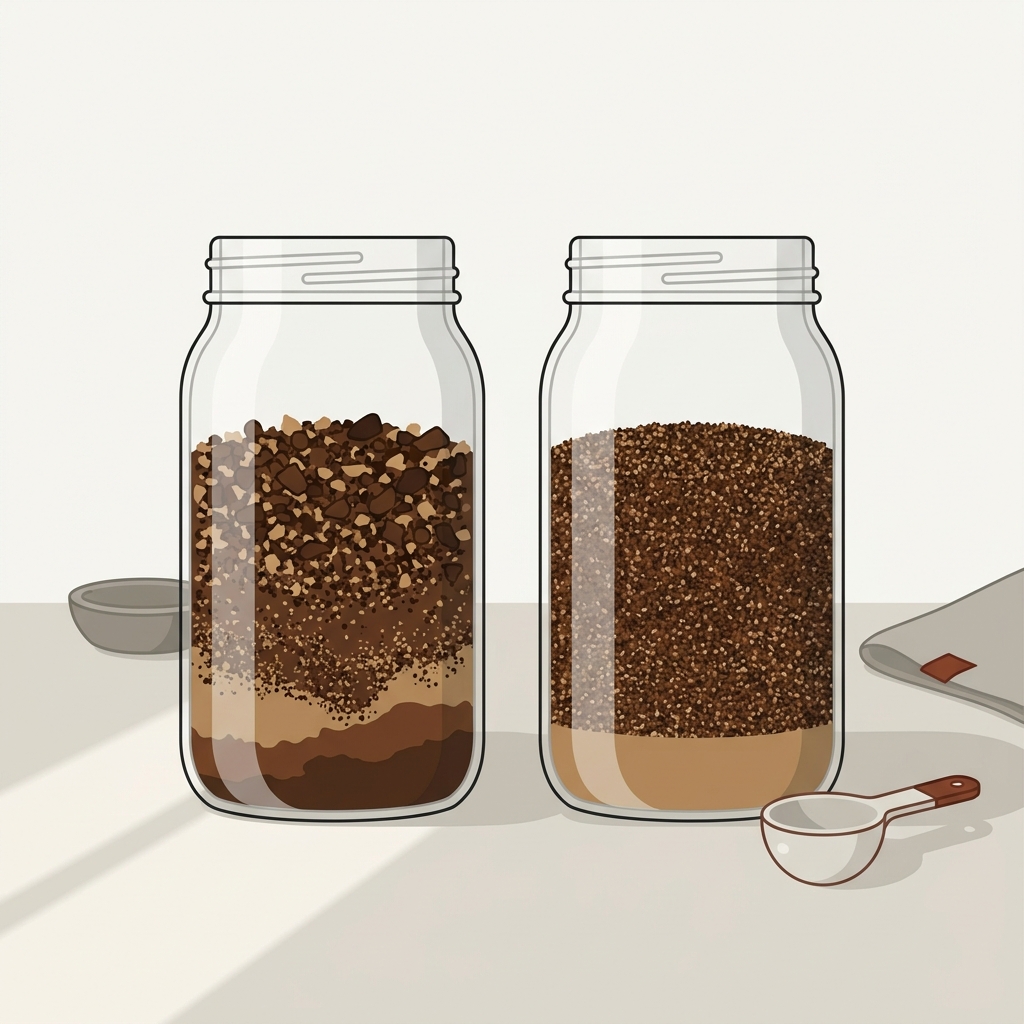
To visualize the difference, think of two sieves. A burr grinder aims to give you a pile that mostly fits through a narrow range of mesh sizes, while a blade grinder leaves a pile with both fine dust and coarse chunks. The finer dust extracts quickly and can contribute bitterness, while large pieces extract slowly and can leave sour or weak flavors, so overall cup clarity and balance suffer when particle-size distribution is wide.
How burr design and settings control grind quality
Burr grinders are not all the same. The shape of the burrs and how they are aligned determines whether the ground output tends toward a single, tight peak of sizes or shows two peaks with a significant amount of fines. Technical discussion and practical examples of how geometry and alignment influence unimodal or bimodal outputs are available from grinder researchers and engineers.
Users tune grind quality by changing the burr setting, adjusting dose, and, when available, calibrating burr alignment. Small changes in setting can shift the distribution enough to affect a recipe, so a grinder with clear, repeatable steps and stable burr alignment is easier to use for precise brewing methods.
Burr size, motor speed and alignment interact; a larger burr or lower RPM does not by itself guarantee better flavour. Prioritize a grinder that can make repeatable adjustments for your brewing method.
When evaluating a grinder, watch for specs and user reports about RPM and burr size, and look for reviewers who measure or describe whether the grinder produces a mostly unimodal distribution or a bimodal one; that distinction helps you predict whether the grinder will produce clarity or a heavier, muddier cup.
Practical adjustments at home include trimming static with a brief tap or a gentle air blast, using a scale and timer to keep dose and brew time constant, and re-checking grind setting when you change beans. These simple habits make it easier to separate a grinder limitation from a brewing error.
Why a narrower grind distribution gives better cup results
Particle-size distribution and fines content strongly affect how water moves through coffee, changing flow resistance, channeling tendency, and ultimately extraction yield; systematic studies link these variables to measurable differences in percolation and yield behavior in espresso and other methods.
When the ground bed is more uniform, flow paths are less likely to form focused channels and extraction becomes more even across the puck or filter bed, which reduces the chance that part of the dose overextracts while another part remains underextracted. That evenness is one reason consistent grind sizing helps hit extraction and TDS targets repeatedly, simplifying recipe adjustments to achieve the SCA Golden Cup ranges.
Fines increase local resistance and can slow or divert flow, producing areas that overextract and drive bitter notes. Conversely, a wide spread with many coarse particles increases the share of underextracted material and can make cups taste thin or sharp. The connection between particle distribution and sensory outcome is both mechanistic and practical: better uniformity gives you more predictable responses when you change dose, temperature, or brew time.
For home brewers this means a dependable grind reduces the need for repeated taste testing and reduces one source of variation when you switch beans or recipes. Reaching SCA targets is not a guarantee of a great cup, but using a consistent grind removes one of the largest variables between a recipe and the result, helping you tune extraction yield and TDS more efficiently.
Head-to-head: what consumer tests and experts show
A burr grinder provides a repeatable adjustment that a timed blade grinder lacks. That control is useful when you change beans or need to make a small correction to a recipe; it is not a guarantee that every burr grinder outperforms every other grinder.
Expert analysis also documents the mechanical reasons behind those differences, noting that blade grinders tend to generate more fines and a wider distribution while well-designed burr grinders can be engineered to favor unimodal outputs or, in some cases, a controlled bimodal profile depending on the sensory goal.
That does not mean a blade grinder is always useless. For coarse methods such as rough-chopped coffee for a rustic French press or when budget and storage constraints are tight, a blade grinder can be acceptable for occasional use. However, for espresso and methods that need precise control over extraction, the variability introduced by blade chopping typically makes it a poor choice.
Consumer testing also highlights another tradeoff: cost. Well-made burr grinders span a wide price range, and price alone does not establish grind quality or suitability. For many home brewers the midrange of burr grinders provides the most meaningful improvement over a blade at a reasonable cost.
coffee grinder burr vs blade
When you compare results directly, the typical pattern is clear: burrs give a controllable, repeatable base to the brewing process, which lets you focus on variables like dose, grind, and time; blades tend to add noise to those experiments, making it harder to learn from each brew. This pattern shows up in both lab-based evaluations and home-user testing.
Common mistakes, troubleshooting and maintenance
User errors often mimic grinder limitations. Inconsistent dosing, shifting grind settings without re-tamping or re-measuring dose, and allowing static or clumps to change the effective particle distribution can all produce the same cup problems you might blame on the grinder itself.
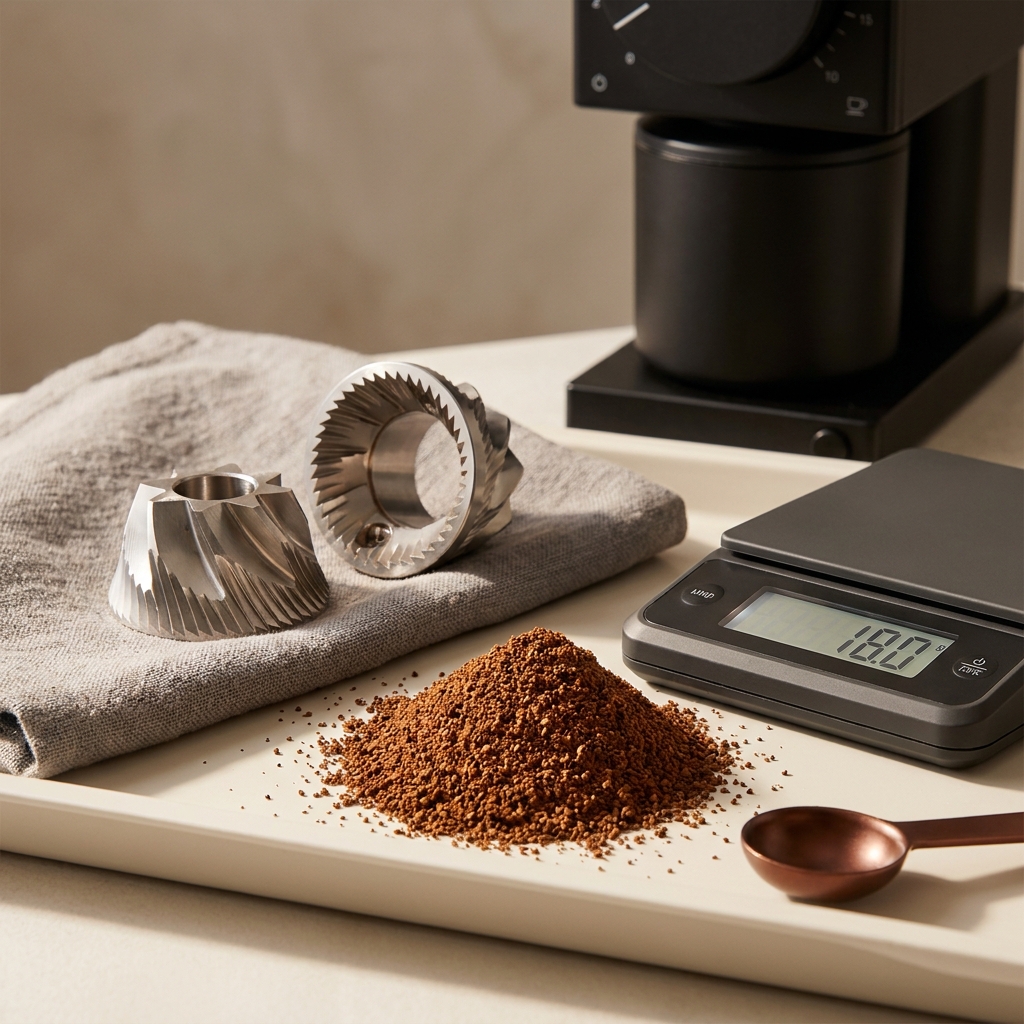
Basic grinder maintenance reduces variability. Regular cleaning of the burrs and chute prevents old grounds from contaminating fresh doses, and periodic inspection for burr wear will flag when the grinder loses its ability to hold a stable distribution. Technical writeups describe how misalignment or worn burrs broaden output and degrade consistency.
To troubleshoot, start by standardizing dose and brew recipe, then compare consecutive brews with the same beans and settings. If results still vary, clean the grinder and check for worn parts or loose fittings. If the distribution seems unusually dusty or if a growing share of coarse fragments appears, the burrs may need replacement or professional servicing.
Unplug the grinder before cleaning or removing parts. Follow the manufacturer’s instructions, brush accessible dry grounds away, and keep water away from the motor and burrs unless the manual explicitly permits it. Reassemble correctly before running the grinder again.
How to choose a grinder and next steps
Start with your brew method. Espresso demands the finest control and the tightest distribution, while pour-over benefits from a stable medium-fine grind and predictable adjustments. For French press a coarse but repeatable output is sufficient, and in that case a modest burr grinder can already offer large improvements over a blade. The SCA Golden Cup targets provide a useful quality goal for brewed coffee, and grinding consistency directly supports meeting those ranges.
A simple at-home comparison will help decide whether to upgrade. Grind two identical doses from your current grinder at a typical setting, then grind two matching doses on a burr grinder if you can borrow one. Brew them using the same recipe and compare clarity, bitterness, and body. If the burr-produced cups are more consistent and easier to dial in, an upgrade will likely improve daily brewing results.

Another quick test is a visual settling comparison: leave two small samples in clear containers, tap them gently, and watch how the fines settle around the larger particles. A sample with more visible fine dust and uneven particle segments points to a wider distribution, which often correlates with less predictable extraction.
When selecting a burr model, prioritize consistent adjustment steps, burr size and quality, and user-friendly dosing. For many home brewers a midrange burr grinder gives the most reliable improvement over a blade at a manageable price, while higher-end models offer tighter tolerances and features that reduce trial and error. For more buying guidance see our grinder shortlist.
When selecting a burr model, prioritize consistent adjustment steps, burr size and quality, and user-friendly dosing. For many home brewers a midrange burr grinder gives the most reliable improvement over a blade at a manageable price, while higher-end models offer tighter tolerances and features that reduce trial and error.
Frequently asked questions
Do burr grinders always make coffee taste better?
Not always. Burr grinders improve grind uniformity, which makes extraction more predictable, but taste also depends on beans, roast, brew technique, and recipe.
Can a blade grinder be OK for some methods?
Yes. For very coarse brewing like a coarse French press or occasional use, a blade grinder can be acceptable, but it will be harder to achieve consistent results for pour-over or espresso.
How often should I replace burrs?
Replacement frequency depends on use and burr material; watch for growing inconsistency, more fines, or increased grind times as signs that burrs may need servicing or replacement.
If you are aiming for clearer, more repeatable results, a burr grinder solves one of the largest technical sources of variability in home brewing. Start with the decision checklist and a short at-home test to see whether the change makes a noticeable difference for your preferred brew method. Small, consistent improvements in grind quality often translate directly into more enjoyable and reliable cups, making the grinder upgrade a practical next step for many home enthusiasts.
For an example of adjusting one variable at a time, see Baratza’s guide to dialing in espresso.