
The journal
How long do coffee grinders usually last?
A practical answer in the context of coffee grinder static: what really determines grinder life, why static isn’t a sign of failure, and the simple maintenance and checks that keep a grinder working for years.
There is no single useful age at which every coffee grinder should be replaced. Its workload, condition, care, construction and available replacement parts matter more than an unsupported “five years” or “ten years” rule. Decide whether yours is working consistently and whether a fault can be serviced before replacing the complete grinder.
The maker guidance used here explains maintenance, not a guaranteed lifespan. Baratza’s cleaning guide describes removing retained grounds and oils, while Breville’s grinder-cleaning guide explains care and symptoms that warrant attention. Neither establishes a universal replacement birthday for every model.
Separate wear from a maintenance problem
Record what has actually changed: output, adjustment behaviour, unusual noise or the cup you get from a familiar recipe. Check the user manual before opening or cleaning anything. Follow its power-disconnection, disassembly and reassembly instructions, and stop using equipment if you suspect an electrical or mechanical fault.
On a model designed for user cleaning, remove residue by the permitted method and check that removable parts are seated correctly. Breville advises keeping burrs dry and warns against using rice as a grinder cleaner. A cleaning method from one model is not automatic permission to dismantle another.
Check whether the affected part is replaceable
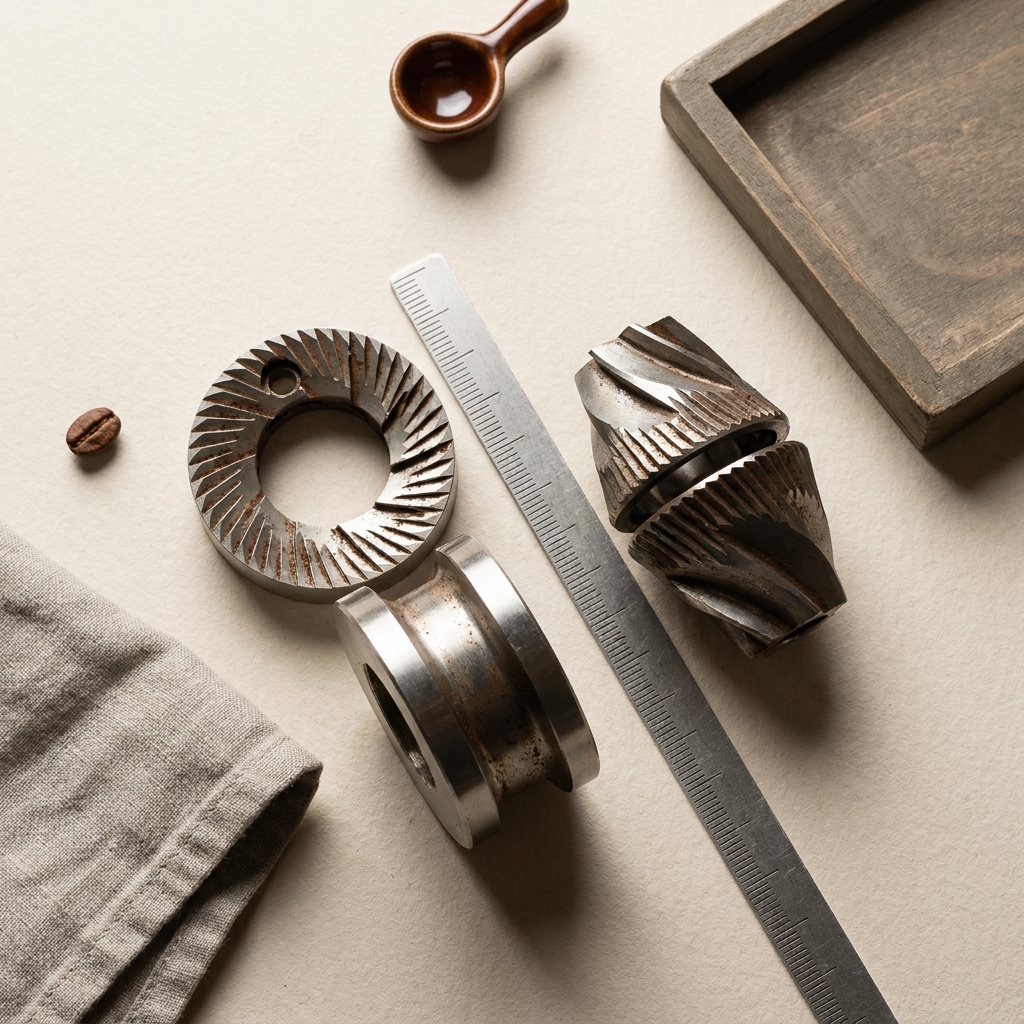
Burrs are not the whole grinder. On a serviceable machine, a worn or damaged component may have an approved replacement, but first identify the exact model and part number. Check the maker’s service documentation or ask its support team to interpret the symptoms. Slower output alone does not prove that the burrs are worn.
Before ordering, confirm compatibility, who is permitted to fit the part and any alignment or calibration procedure. Do not assume that two burrs with a similar diameter are interchangeable. Likewise, a machine with no obvious user-accessible adjustment may require professional service rather than a more forceful attempt to open it.

Use workload as context, not a countdown
A grinder used occasionally and one used throughout each day do not have the same workload simply because they were bought in the same year. If your manufacturer gives a service interval or throughput figure for your model, use that specification in its stated context. Do not convert an unrelated commercial model’s rating into a home-grinder lifespan.
Keep the purchase details, model, cleaning notes and any service record together. A warranty period describes the warranty terms; it is not, by itself, a prediction of when the machine will stop working.
Repair or replace?
Compare a confirmed repair’s parts, labour, availability and expected usability with the cost of a suitable replacement. If the grinder still works as intended, its age alone is not a reason to discard it. If the fault cannot be repaired safely or approved parts are unavailable, replacement may be the practical choice.
Put this into practice
Separate routine cleaning, a replaceable worn part and a fault requiring service in your notes. A grinder’s age alone does not tell you which option is appropriate, so ask about the actual symptom and model.
Assess your grinder before replacing it